

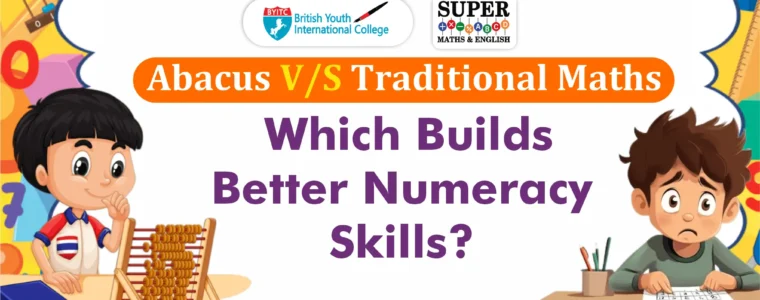
Abacus vs Traditional Maths is a common debate among parents who want to choose the right approach for their child’s mathematical development. Every parent wants their child to feel confident with numbers, not scared of them. Both methods aim to strengthen numeracy skills, but they differ in technique, engagement level, and how they stimulate the brain. Understanding the differences can help you decide which maths learning method is best for your child based on their personality and learning style.
Abacus vs Traditional Maths
Understanding Traditional Maths
Traditional maths is what most of us grew up learning in school. It focuses on textbooks, written calculations, memorisation of formulas, and step-by-step problem-solving. This method follows a structured curriculum and builds a strong academic base.
Advantages of Traditional Maths:
- Builds a clear conceptual understanding of formulas and procedures
- Encourages logical and analytical thinking
- Prepares students effectively for school exams
- Covers a wide range of mathematical topics in depth
Traditional maths plays an important role in shaping academic success. However, it sometimes relies heavily on rote learning. Children may know the steps but take more time solving problems mentally. This is where the comparison of the Abacus vs Traditional Maths becomes meaningful for today’s parents.

Understanding Abacus Learning
The abacus may look like a simple bead frame, but it is much more than that. It is an ancient calculation tool that has evolved into a powerful brain development technique. Abacus training focuses on improving memory, concentration, and mental math skills.
Benefits of Abacus Learning:
- Enhances concentration and visualisation
- Improves calculation speed and accuracy
- Strengthens memory retention
- Builds confidence in solving sums
When we look at Abacus vs Traditional Maths, one major difference is brain involvement. The abacus activates both sides of the brain, encouraging children to visualise numbers and perform calculations mentally. This early mental training makes it a strong candidate for the best maths learning method for kids, especially during foundational years.
Key Differences: Abacus vs Traditional Maths
Here are some simple ways to understand the distinction:
1. Speed and Mental Calculation
In Abacus vs Traditional Maths, the abacus clearly helps improve mental speed. Children learn to imagine the beads and solve sums quickly without needing paper and pencil.
2. Conceptual Depth
Traditional maths provides a deeper theoretical understanding, which becomes essential in higher classes and competitive exams.
3. Confidence and Motivation
Children who practice the abacus often feel more confident because they can calculate faster. This confidence positively affects their classroom performance.
4. Learning Experience
Abacus sessions are usually interactive and activity-based, while traditional maths is more structured and syllabus-focused.
Because of these differences, many experts believe that combining both approaches can create the best maths learning method for kids.
Which One Builds Better Numeracy Skills?
The truth is, there is no single winner in the discussion of the Abacus vs Traditional Maths. If your goal is strong academic depth, traditional maths is essential. If you want faster calculations, sharper focus, and improved memory, abacus training adds great value.
For younger children, especially, the abacus builds a strong numerical base that makes school maths easier and less stressful. When blended thoughtfully, both methods together can become the best maths learning method for kids, offering both speed and understanding.
Conclusion
In the end, Abacus vs Traditional Maths is not about choosing one and rejecting the other. It’s about understanding what your child needs at their stage of learning. Traditional maths builds academic strength, while the abacus nurtures mental agility and confidence. A balanced combination often works best. By integrating both methods, parents can truly offer the best maths learning method for kids, helping them grow into confident and capable learners for years to come.
Related Blogs
The Abacus Maths Method: a Transformative Method for Cognitive Development and Learning Challenges
How does Abacus Improve Creativity Among Children?
How Game-Based Maths Learning can build a Strong Maths Foundation?
The Science Behind the Abacus?
Research showing Abacus benefits!
Abacus Online Classes in London | Abacus Maths Classes in Columbus | Abacus Maths Classes in Long Beach | Abacus Maths Classes in Oakland | Abacus Maths Classes in Indianapolis | Abacus Maths Classes in Baltimore | Abacus Maths Classes in Atlanta | Abacus Maths Classes in Arlington | Abacus Maths Classes in Raleigh | Abacus Maths Classes Near Me | Abacus Maths Classes in Sacramento