

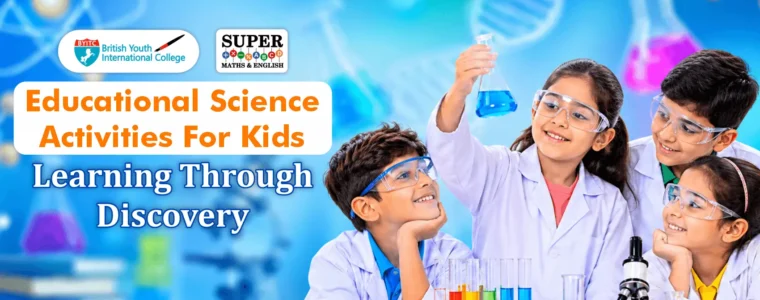
When parents start searching for Educational Science Activities for Kids, they are often looking for more than ways to keep children busy. They are trying to find activities that will make the learning process fun, engaging, and that will teach children about the world around them.
Science becomes much easier to understand when children can see, touch, test, and question what they are learning. Simple experiments are the perfect solution to this problem. Whether at home or in the classroom, these activities can be used to teach children a lesson on a particular subject.
So, Why Choose Educational Science Activities for Kids?
Children naturally ask questions: Why does ice melt? Why do things float? How does a plant grow? What makes a rainbow? These questions are the starting point of scientific thinking.

Well-planned Educational Science Activities for Kids give children an opportunity to explore those questions instead of simply memorising answers. They can make predictions, conduct simple experiments, observe changes, and discuss what happened.
This discovery-based approach makes Science for Kids more engaging while helping children develop skills they can use across different areas of learning.
Building Curiosity Through Simple Experiments
Science experiments don’t necessarily mean a big budget. Water in a glass, ice cubes, paper, food coloring, or household items are enough to make great learning tools.
As an illustration, kids could experiment by putting various items in the water and guessing whether each will stay on the surface or be submerged. Then, when the outcome is known after running the experiment, the kids can identify the differences and have a conversation about why one item floats and another doesn’t.
The activity teaches more than the concept of floating and sinking. It also introduces children to prediction, observation, comparison, and reasoning.
Boosting Confidence Through Discovery
One of the biggest benefits of practical Science for Kids is that children get to discover answers themselves.
When a child makes a prediction and checks the result, whether accurate or even inaccurate, it helps the child learn. The child no longer believes that being wrong is the same as being mistaken but starts believing that a wrong guess may also be a step towards discovering things.
This can build confidence and encourage children to ask more questions.
What Are Some Educational Science Activities for Kids?
Parents and teachers can introduce science through activities connected to everyday experiences.
Exploring Plant Growth
Grow beans or other fast-growing plants for children that they can use to see and understand how living things change through time. Simple activities like noting plant heights, seeing when new leaves develop, or merely looking at the difference in the plants grown under various conditions will be enough for kids so that they can keep track of what is happening to the plants and also be aware of the outcomes.
This activity introduces basic ideas about plants, growth, water, sunlight, and observation.
Creating a Simple Water Experiment
Children get to see what evaporation is when they put equally sized cups of water in several places and check how much water there is after a few days.
They can even take notes of their findings and talk about the reasons that water is lost quickly in some cases. In this way, the disappearance of water on a usual day transforms into a great example of science.
Learning About Magnets
Using a safe magnet and a collection of everyday objects, children can predict which materials will be attracted to it. They can sort the objects into groups and compare their predictions with the results.
It is a simple way to introduce children to magnetism and material properties.
How Can Parents Make Science More Meaningful?
The key is to encourage children to ask questions rather than rush to provide answers. Ask, “What do you think will happen?” before an experiment and “Why do you think that happened?” afterwards.
With the right approach, Educational Science Activities for Kids can transform ordinary moments into opportunities for discovery.
Science is not merely something that kids obtain from their books at school. It is around them all the time. By encouraging children to observe, experiment, question, and explore, parents and educators can make Science for Kids both enjoyable and genuinely educational.
Related Articles
How Hands-On Science Classes Boost Children’s Confidence
What Parents Should Look for in Science Classes for Kids Nearby
GCSE Computer Science Made Easy: Top Tips to Ace Your Exam!
Boost Your Grades: The Ultimate Guide to GCSE Computer Science Success
Educational Science Activities Classes for Kids in London | Science Activities Classes for Kids in Birmingham | Science Classes for Kids in Manchester | Science Classes for Kids in Leeds | Science Classes for Kids in Liverpool | Science classes for kids in London | Science classes for kids in Manchester | Science classes for kids in Birmingham | Science tuition for kids in Leeds | Kids science classes in Leeds | Kids science classes in Bristol | Kids science classes in Sheffield